[ Previous
| Table of Contents | Next
]
- one of the first groups to write most of its own material
- transformed the sound of rock & roll
- moved from simple love songs to perfectionistic studio extravaganzas
- simply put, the Beatles influenced every act that came after them
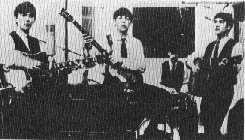
click here to see some
interesting photos
- John and Paul met at a church picnic (7/6/57) where John's "Quarry
Men" were playing
- John formed the band after hearing "Rock Island Line," a smash
skiffle hit by Lonnie Donegan
- "skiffle" style
- simple, 3-chord style featuring easily accessible instruments (guitar/banjo,
washboard, "bass" made from a broom handle & wooden chest)
Contrast John & Paul:
- John Lennon
- creative talent was balanced by rebellious, delinquent side
- his parents weren't around much
- --mother left to live with another man within a year of John's birth
- -- father worked at the shipyard
- his care fell to his aunt & uncle to whom he became quite a burden
- grades declined
- heard Elvis & other rock music on Radio Luxembourg (BBC wouldn't
play)
- basically, rebellious & iconoclastic
- Paul McCartney
- father (Jim) ran a rather successful society band (The Jim Mac Jazz
Band) in the 20s
- although right-handed, plays guitar/bass left-handed & strung in
reverse order
- at that same garden party, Paul amazed John & friends with his authentic
renditions of Little Richard tunes (hear him sing "")
- essentially, practical and business-like to the point of being stingy
Forming the Band:
- Paul's friend (George Harrison) began hanging
out with the Quarry Men (now called Johnny & the Moondogs)
- younger than the others and John considered his presence an intrusion
- eventually Paul convinced John to let George join
- Stu Sutcliffe (talented student at Art College
where John continued studying) bought a bass, determined to join John's band
- as the band planned for a low-budget, second-rate Scottish tour, the manager
recommended a name change
- Stu suggested the "Beetles" (reference to Holly's "Crickets")
- John came up with the idea of misspelling
- finally, the "Silver Beatles"
- May 1960 - the band was not very good
- Stu could hardly play, no stage act, no stage costumes
- currently drummerless ... Tommy Moore would play drums with them at
times
- Prior to their 1st (of 4) 2-month booking in Hamburg (summer
1960), Paul approached a local drummer, Pete Best
(handsome w/glittering new drum set), about joining the band
- found themselves in the Indra (a "dive" on the "wrong
end" of a "happenin'" city)
- eventually moved to the "Kaiserkeller," sharing the stage
with other acts.
- Sets were 4½ hours per night
- repertoire consisted of lots of covers (Holly, Berry, Perkins, Little
Richard, etc.)
- began developing stage show
- Pete Best was distinct from the others
- he was strikingly good looking ... girls looked past the others and
oogled Pete
- did not join in on the increasingly outrageous stage show, nor the after-hours
partying
- shortly after abandoning Herr Koschmider's Kaiserkeller for a new club (the
Top Ten club), George was deported by the German authorities
- it was discovered that he was underage and had no work permit
- after getting into further trouble with the law following Paul's "inadvertent"
setting curtains on fire, the other Beatles followed him home
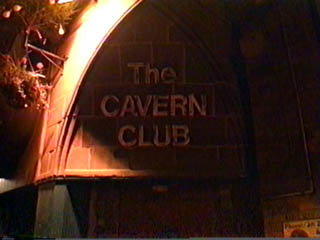
- Cavern Club (Liverpool) - underground cellar that had been a jazz club,
began showcasing local talent

- popularity of the new "beat" sound
- began to build a loyal Liverpool following
- mid-1961 - returned to Hamburg's Top Ten club
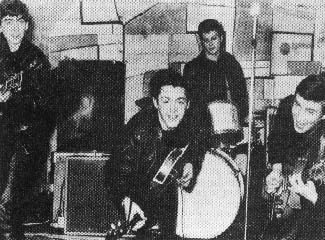
- alternated sets with Tony Sheridan
- Stu's musical ineptitude became glaringly obvious and he had become
more interested in art & girlfriend
- Stu left the band and Paul moved to bass
- made their 1st commercial recording
on this trip
- as backup band for Tony Sheridan ("My
Bonnie Lies Over the Ocean" and "When the Saints Go Marching
In")
My Bonnie (later, hit #26 on US charts, 3/64)
- as the Beat Brothers ("Ain't She Sweet"
and the instrumental "Cry For a Shadow"); Sheridan recording became
a minor hit in Germany
- it was this recording that Beatles fans in Liverpool began requesting
at the local record store
- store manager (Brian Epstein) became curious
and sought out the Beatles … eventually became their manager
- 1962 - Brian began searching for record contract
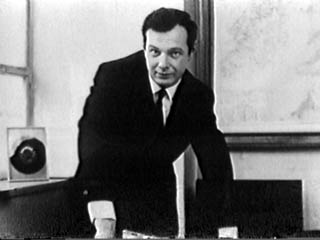
- refused by almost every record label in Britain
- they recorded 15 songs in the Decca studios, but under pressure these
recordings were not impressive
- having decided to sign only one "beat" group, Decca
decided to go with Brian Poole & the Tremeloes instead!!
- angered, Epstein warned the execs that one day his band would be bigger
than Elvis (execs smiled knowingly as he stomped out)
- Brian eventually died from a combination of alcohol and sleeping pills
(8/27/67) ... he no longer felt needed
- 4/62 - landing in Germany, Beatles learned that Stu had died that day!
- 6/62 - due to the foresightedness of producer George
Martin of Parlophone (bottom of the totem pole of the EMI subsidiaries),
the Beatles were awarded a 1-year, 4-song contract
- Martin wanted to bring the "beat" sound and his record label
to higher status & respectability
- 8/16/62 - Pete was asked to leave the band
(he appeared on "I've Got a Secret" TV show two years later)
- wasn't fitting in musically or personally
- replaced by local drummer for Rory Storme & the Hurricanes (Richard
Starkey, a.k.a., Ringo Starr)
- 9/62 - recorded "Love Me Do," and "P.S. I Love You"
- released 10/4 and "Love Me Do" managed to reach #17 with very
little airplay
- Ringo replaced by session drummer (Andy White) on these tunes – he played
tambourine
Love
Me Do
(US #1, 5/64)
- late November - recorded "Please, Please Me"
- Martin assured the Beatles upon hearing the final version that they
had a #1 hit
- his prediction came true in Britain on 3/2/63
Please
Please Me
(UK #1, 3/63; US #3, 2/64)
- followed with an album of newly recorded tunes
- originals included "I Saw Her Standing There" and "Do
You Want To Know a Secret"
- covers included "" by the Isley Brothers
- 4/63 - 3rd Parlophone release ("From Me to You") hit
#1
- with Gerry & the Pacemakers (another of Brian's acts) also on the
charts, people began speaking of the "Liverpool
sound" or "Mersey beat"
(Mersey River in Liverpool)
From Me to You
(UK #1, 4/63)
- the Beatles were given top billing over Roy Orbison on a British tour
- British Beatlemania had begun
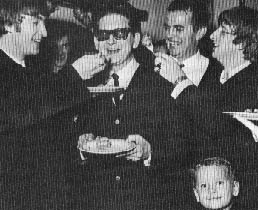
- 4th hit ("She Loves You") went
to #1 in the UK, based on advance sales!!!
- became the biggest selling single in British history
- so began the series of TV performances, Swedish tour, and Royal Command
Performance (11/63)
She
Loves You
(UK #1, 1963; US #1, 2/64)
late 1963 - British version of Beatlemania is in full swing
- newspaper articles & interviews
- Beatles are charming & witty
- radio & television appearances
- Beatles products: Beatle wigs, Beatle clothes, Beatle dolls, lunch pails,
cartoon series
- due to Epstein's ineptitude, the Beatles saw very little of this revenue
- opened the American musical market to other British
bands
- attempts to get Capitol records (EMI's American label) interested in the
Beatles had failed
- Martin licensed early singles to independents Vee-Jay & Swan
- persuaded them, however, to release the 4th single ("I
Want to Hold Your Hand") and a follow-up album (Meet the Beatles)
- with the release of "I Want to Hold Your Hand" (#1), Parlophone
had held the #1 slot for 37 of the past 52 weeks
The Sound of the Beatles LIVE, pre-American Beatlemania
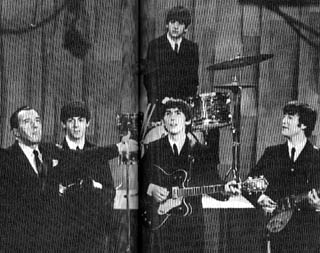
A very interesting pespective about the Beatles' live sound is provided by Coling Fleming in this article in the Atlantic entitled "50 years later: The greatest Beatles performance of all time, (Oct. 24, 2013)," in which he claims that this performance debunks the myth that the Beatles sounded terrible in performance. There are numerous recordings included of a performance before an audience of about 100 people at Stockholm's Karlaplansstudion on October 24, 1963; thankfully, this performance was broadcast over the radio and is now available on YouTube. This performance was during a period when, less than a year ago, the band had completed their last residency at Hamburg's Reeperbahn distric and preceding their surreal arrival in Amercan in February 1964 and the infamous Ed Sullivan Show appearances. Noticeably absent from this recording is the hysterical screaming that became a part of Beatles live performances shortly after ... so you can actually hear the band very well; and they sound good! Enjoy this "blast from the past" ...
February 1964 - Beatlemania Arrives in America
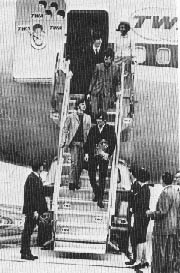
- 2/2/64 - greeted by screaming mob (~5,000)
upon arrival at NY's Kennedy airport
- George Martin looks back on the Beatles' arrival in America
- extended excerpt of scenes from the 1st US tour The Beatles Unauthorized
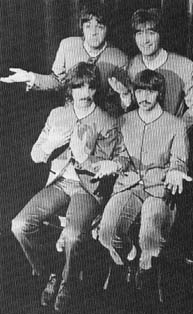
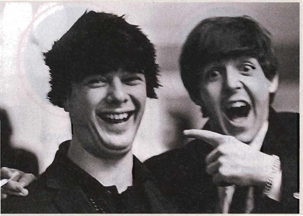
Brian Epstein sporting a "Beatle wig" (with Paul); photo taken in 1964 by Ringo
- often couldn't hear the music at Beatles concerts because of the girls'
screaming
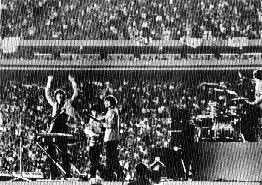
- "they used us as an excuse to just go mad.... We were the ones trapped
in the middle of everyone else going mad." (G. Harrison)
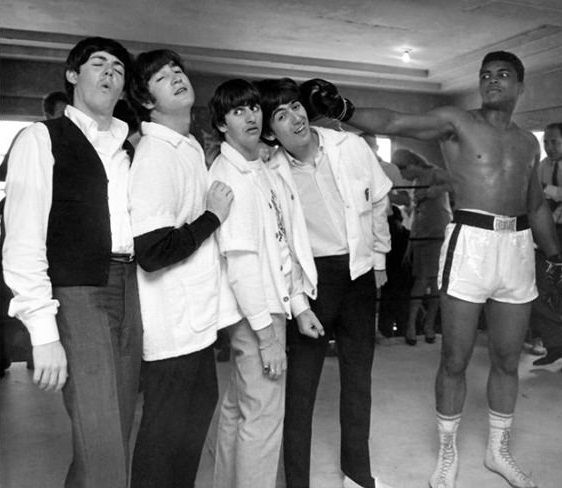
- 2/18/64 - the Beatles meet Cassius Clay (a.k.a. Muhammad Ali)
- 3/28/64 - Beatles have 10
song simultaneously in the Top 100 (!!!!), including "Twist and Shout" (reached #2 ... evidence of Beatlemania)
- surpassed Elvis' previous record of nine (12/56)
- by mid-April, there were fourteen
Beatles singles in the Top 100
- 4/64 - "Can't Buy Me Love" became
first record to top the American & British charts
simultaneously
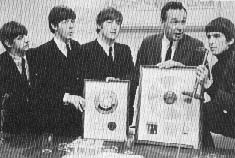
4/4/64 - Beatles held the Top
5 spots on the Billboard Charts
- Can't Buy Me Love
- Twist & Shout
- She Loves You
- I Want to Hold Your Hand
- Please, Please Me
- August, 1964 - Beatles perform at the Hollywood Bowl
1964-65 - life as rock stars was in full swing
By 1965, Lennon & McCartney were rarely writing songs together
August 1965 - release their second movie: Help! ... here's the opening segment, with the absurd "set-up":
- "You're Gonna Lose That Girl"
- "You've Got to Hide Your Love Away" / intermission / Paul gets shrunk:
- "Another Girl" (in the Bahamas):
- returned for 3rd tour in August 1965 at NY's Shea Stadium (8/15/65)
- record for largest concert audience - 55,600
- issued in a new era in rock concerts (outdoor stadium)
- 10/26/65 - awarded the MBE (Member of the Order of the British Empire)
- caused some previous recipients to return theirs
- Lennon returned his in 1969
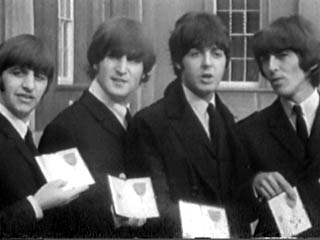

[click photo to see a video interview with the Beatles about this award]
- 1966 - tour of Japan
- performed in the Nippon Budokan Hall (martial arts theater) which was
considered a "violation" by traditionalists
- visit to Japan was scheduled "to the minute" ... hurriedly
rushed from place to place
[Click image above to see an interview of
The Beatles discussing their experience in the Phillipines.]
- tour of the Phillipines - bad experience
- invited to dinner by the Marcos family on their day off, but said "no
thanks"
- government (Emelda Marcos) felt shunned, let her feelings be known
- as a result, the Beatles had substantial difficulty in finding a ride
to the airport
Musical style of the Beatles' Early Period:
- pleasant, upbeat rock tunes
- easy to listen to, dance to, and enjoy
- not revolutionary or profound
[ Previous
| Table of Contents | Next
]